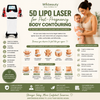
5D Lipo Laser for Post-Pregnancy Body Contouring
, por Kashif Amin, 15 Tiempo mínimo de lectura
Obtén un 5% de descuento en tu primera compra
, por Kashif Amin, 15 Tiempo mínimo de lectura
Post-pregnancy body contouring is one of the most emotionally significant treatment categories in aesthetic practice. This guide covers when it is safe to begin 5D Lipo Laser after pregnancy, which areas respond best, how to combine with RF skin tightening, and how to set realistic expectations for postnatal clients.
Post-pregnancy body contouring is one of the most emotionally significant treatment categories in aesthetic practice.
New mothers often experience profound changes to their body shape, skin quality, and self-confidence after pregnancy and childbirth. The abdominal area in particular — stretched by the growing uterus, affected by hormonal fat redistribution, and often marked by stretch marks and reduced skin elasticity — is the area that most postnatal clients want to address first. For many women, reclaiming their pre-pregnancy body shape is not a vanity concern but a deeply personal goal that affects their confidence, their relationship with their body, and their overall wellbeing.
5D Lipo Laser is an effective and safe option for post-pregnancy body contouring — but the postnatal client requires a specific approach that accounts for the physiological changes of pregnancy and the recovery process. This guide covers everything a practitioner needs to know.
The timing of post-pregnancy body contouring treatment is the first and most important clinical decision a practitioner must make for postnatal clients.
For clients who delivered vaginally without complications, 5D Lipo Laser treatment can typically begin from 8 to 12 weeks postpartum, provided the client has been cleared by their midwife or obstetrician for return to normal physical activity. The 8 to 12 week window allows the body adequate time to complete the initial postpartum recovery — including uterine involution, hormonal stabilisation, and the healing of any perineal trauma — before the additional physiological demand of lipo laser treatment is introduced.
For clients who delivered by caesarean section, the recommended waiting period is longer: 12 to 16 weeks postpartum, or until the caesarean scar is fully healed and the client has been cleared by their obstetrician. The caesarean scar must be completely healed before paddles are placed in the abdominal area, as the laser energy and the physical pressure of the paddles could interfere with scar healing if applied too early.
Always obtain written confirmation from the client that they have been cleared by their healthcare provider before beginning treatment. Document this confirmation in the client’s file. Never begin postnatal treatment without this clearance, regardless of how well the client appears to have recovered.

Pregnancy produces a range of physiological changes that directly affect the 5D Lipo Laser treatment plan and the results that are achievable.
The abdominal skin is typically significantly stretched after pregnancy, with reduced elasticity and often visible stretch marks. The degree of skin laxity depends on the size of the pregnancy, the client’s age, and their pre-pregnancy skin quality. Skin laxity is the primary factor that determines whether RF skin tightening should be included in the postnatal treatment plan — and for the vast majority of postnatal clients, it should be included from the first session.
The abdominal muscles are often weakened and separated after pregnancy — a condition called diastasis recti — which affects the structural support of the abdominal wall and must be assessed before treatment begins. Diastasis recti does not contraindicate 5D Lipo Laser treatment, but it does affect the treatment plan and the realistic outcome, and it must be communicated clearly to the client.
Hormonal changes after pregnancy — particularly the decline in oestrogen and the elevation of prolactin in breastfeeding mothers — affect fat distribution and the rate of fat mobilisation. Postnatal fat, particularly in the abdominal area, tends to be softer and more responsive to lipo laser treatment than pre-pregnancy fat, which is a positive factor for treatment outcomes.
The abdomen is by far the most commonly requested and most clinically appropriate treatment area for postnatal clients. The subcutaneous fat that accumulates in the abdominal area during pregnancy is typically soft, responsive, and directly accessible to the laser energy. A well-designed abdominal course can produce a significant circumference reduction and, when combined with RF skin tightening, a meaningful improvement in skin firmness and texture.
The flanks are the second most commonly requested area for postnatal clients. Pregnancy-related fat accumulation in the flank area is common and responds well to treatment. Treating the abdomen and flanks in combination delivers the most complete waist contouring result and is the most popular course structure for postnatal clients.
The inner thighs are a frequently requested area for postnatal clients who experienced significant thigh fat accumulation during pregnancy. The inner thigh fat in postnatal clients is typically soft and responsive, and the inner thigh protocol delivers consistent results in this population.
The upper arms are increasingly requested by postnatal clients, particularly those who experienced significant arm fat accumulation during pregnancy or who are concerned about skin laxity in the posterior upper arm. The upper arm protocol, combined with RF skin tightening, is appropriate for postnatal clients from 12 weeks postpartum.
RF skin tightening is essential for postnatal body contouring — more so than for any other client group. The abdominal skin of a postnatal client has been significantly stretched during pregnancy, and the degree of skin laxity is typically greater than in non-postnatal clients of the same age and body composition.
As the subcutaneous fat reduces during the lipo laser course, the abdominal skin must firm and contract to follow the new, smaller volume. Without RF skin tightening, the skin may not firm sufficiently, resulting in a loose, crepey appearance that is often more distressing to the client than the original fat concern. For postnatal clients, this risk is significantly higher than for non-postnatal clients, and RF skin tightening should be included from the first session without exception.
Apply the RF treatment to the abdominal area immediately after the lipo laser session, while the tissue is warm and the lymphatic system is active. For postnatal clients with significant skin laxity, extend the RF treatment to 15 to 20 minutes per session and increase the intensity progressively over the course as the skin’s collagen density improves.
The collagen remodelling process stimulated by RF treatment continues for up to three months after the final session. Postnatal clients should be advised that the skin tightening result will continue to develop after the course is complete, and that the full result — including the skin quality improvement — will be visible at the three-month post-course review.
Diastasis recti — the separation of the rectus abdominis muscles along the midline of the abdomen — affects a significant proportion of postnatal clients and must be assessed before abdominal treatment begins.
Diastasis recti does not contraindicate 5D Lipo Laser treatment. The laser energy targets subcutaneous fat, not the underlying muscle structure, and the treatment does not exacerbate or worsen diastasis recti. However, the presence of diastasis recti affects the realistic outcome of abdominal treatment in two ways.
First, the abdominal protrusion caused by diastasis recti — the characteristic "mummy tummy" or "belly pooch" that persists despite fat reduction — is caused by the separation of the abdominal muscles, not by subcutaneous fat. Lipo laser treatment will reduce the subcutaneous fat layer but will not address the muscle separation that causes the protrusion. Clients with significant diastasis recti should be advised that the lipo laser result will be limited by the underlying muscle separation and that physiotherapy or EMSlim muscle toning may be needed to address the structural component of their concern.
Second, the presence of diastasis recti means that the abdominal wall is structurally weakened, and the practitioner should avoid placing paddles directly over the midline separation. Position the paddles to either side of the midline, covering the lateral abdominal fat deposits, and avoid direct pressure on the separation itself.
The session protocol for postnatal clients follows the standard lipo laser protocol for the relevant treatment area, with three specific modifications.
First, begin with a conservative pad configuration — 8 paddles for the abdominal area — and increase to 10 or 12 paddles from session three onwards as the client’s comfort and the tissue response are established. Postnatal abdominal tissue is often more sensitive than non-postnatal tissue, and a conservative start ensures that the client’s first experience is comfortable and positive.
Second, include RF skin tightening from the first session without exception, as described above. The RF component is not optional for postnatal clients.
Third, take circumference measurements at every session and share the data with the client. Postnatal clients are often highly motivated by measurable progress and respond strongly to the objective evidence of circumference reduction. Sharing the data at every session maintains motivation and supports course completion.
The recommended course length for postnatal abdominal treatment is 10 to 12 sessions, delivered once or twice per week. A longer course than the standard 10 sessions may be appropriate for clients with a larger starting circumference or more significant skin laxity.
Postnatal clients can achieve excellent results from a well-designed 5D Lipo Laser course, and in many cases the results are more dramatic than those achieved by non-postnatal clients of the same age, because postnatal abdominal fat is typically softer and more responsive to treatment.
A standard 10 to 12 session abdominal course for a postnatal client can deliver a circumference reduction of 6 to 12 centimetres at the navel, a visibly flatter abdominal profile, and a meaningful improvement in skin firmness and texture when RF skin tightening is included. The result is typically most dramatic for clients who begin treatment within six months of delivery, when the postnatal fat is at its most responsive.
Set realistic expectations about the skin quality result. Significant stretch marks will not be eliminated by lipo laser or RF treatment, but their appearance can be improved by the collagen stimulation of the RF component. The skin surface will be firmer and smoother, but clients with extensive stretch marks should be advised that the marks themselves will remain, albeit with improved texture and reduced prominence.
The question of whether 5D Lipo Laser treatment is safe for breastfeeding mothers is one of the most common questions in postnatal body contouring practice.
The current guidance is that 5D Lipo Laser treatment is not recommended for clients who are actively breastfeeding. The primary reason is not that the laser energy poses a direct risk to the breastfeeding mother or infant, but that the fatty acids released during the treatment enter the bloodstream and lymphatic system and may be present in breast milk in the hours following the session. While the clinical significance of this is not definitively established, the precautionary principle applies: until there is clear evidence that the released fatty acids do not affect breast milk composition or infant health, breastfeeding mothers should be advised to wait until they have weaned before beginning treatment.
Advise breastfeeding clients to return for their consultation and begin treatment after weaning. This is not a permanent contraindication — it is a temporary precaution that protects the infant and the practitioner.
The aftercare protocol for postnatal clients follows the standard aftercare guide, with one practical consideration: postnatal clients are often sleep-deprived, time-constrained, and managing the demands of a new baby alongside their treatment. Aftercare advice should be practical, realistic, and framed in terms of what is achievable given the client’s circumstances.
Encourage postnatal clients to walk with the pram for 20 to 30 minutes after each session. This is a practical and achievable aftercare action that fits naturally into the daily routine of a new mother and delivers the lymphatic stimulation needed to maximise the treatment result.
Advise postnatal clients to drink at least two litres of water per day. Hydration is particularly important for postnatal clients, many of whom are mildly dehydrated from the demands of new parenthood. Adequate hydration supports both the lymphatic elimination of the released fatty acids and the overall energy and wellbeing of the client.
The Wikbeauty 5D Lipo Laser delivers the precise, multi-depth fat cell stimulation needed for effective postnatal body contouring — with five wavelengths targeting the full depth of the subcutaneous tissue and a configurable paddle system that adapts to the postnatal abdominal area.
The machine operates across five wavelengths — 650nm, 780nm, 808nm, 940nm, and 980nm — targeting fat cells at multiple depths simultaneously. Output energy is 209mW, powered by Japan Mitsubishi diode laser lights for clinical-grade precision in every session. The paddle system is configurable across 8, 10, 12, or 14 paddles, with 28 diode lasers per paddle, adapting to any body area and client profile. Wind cooling maintains a consistent operating temperature throughout every session, and both continuous and time-setting operation modes give the practitioner full control over every treatment.
Postnatal body contouring clients are among the most motivated, most grateful, and most loyal clients in aesthetic practice. A practitioner who delivers a meaningful, visible result for a postnatal client — and who does so with sensitivity, professionalism, and genuine care — earns a client for life and a referral source that grows with every new mother in their community.
⭐ Wikbeauty supplies professional-grade 5D Lipo Laser machines to aesthetic clinics worldwide — with complete postnatal protocols, area-specific guides, and clinical support included as standard.
👉 Browse Professional 5D Lipo Laser Machines at Wikbeauty— and speak to our team about building a postnatal body contouring programme that supports new mothers and grows your clinic.
For vaginal deliveries without complications, treatment can typically begin from 8 to 12 weeks postpartum, provided you have been cleared by your midwife or obstetrician for return to normal physical activity. For caesarean deliveries, the recommended waiting period is 12 to 16 weeks, or until the caesarean scar is fully healed and you have been cleared by your obstetrician. Always obtain medical clearance before beginning postnatal body contouring treatment.
The current guidance is that 5D Lipo Laser treatment is not recommended for clients who are actively breastfeeding. The fatty acids released during treatment enter the bloodstream and may be present in breast milk in the hours following the session. As a precautionary measure, breastfeeding mothers are advised to wait until they have weaned before beginning treatment.
Yes, 5D Lipo Laser can significantly reduce the subcutaneous fat layer in the abdominal area after pregnancy, producing a flatter, firmer abdominal profile. When combined with RF skin tightening, the treatment also improves skin firmness and texture. However, if your abdominal protrusion is caused by diastasis recti — separation of the abdominal muscles — the lipo laser will reduce the fat but will not address the muscle separation. Your practitioner will assess for diastasis recti at the consultation and advise on the most appropriate treatment plan.
A standard postnatal abdominal course consists of 10 to 12 sessions, delivered once or twice per week. Clients with a larger starting circumference or more significant skin laxity may benefit from a longer course. The recommended course length will be discussed at the consultation based on your specific goals and starting point.
The RF skin tightening component of the treatment stimulates collagen production in the dermis, which can improve the texture and appearance of stretch marks over the course of treatment. Stretch marks will not be eliminated, but their appearance — particularly the texture and prominence — can be meaningfully improved. The skin tightening result continues to develop for up to three months after the final session.