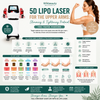
5D Lipo Laser for the Upper Arms: Slimming and Tightening Protocol
, di Kashif Amin, 15 tempo di lettura minimo
Ottieni il 5% di sconto sul tuo primo acquisto
, di Kashif Amin, 15 tempo di lettura minimo
The upper arms are one of the most self-consciousness-inducing body concerns for women over 35. This guide covers the complete 5D Lipo Laser upper arm protocol — pad placement, session structure, the essential role of RF skin tightening, realistic results, and how to manage client expectations from consultation to final session.
The upper arms are one of the most emotionally loaded body contouring concerns in aesthetic practice.
For many women — particularly those over 35 — the upper arms are the area that most affects their clothing choices, their confidence in sleeveless tops, and their willingness to raise their arms in social situations. It is an area that is notoriously resistant to exercise — the tricep fat pad in the posterior upper arm is one of the most hormonally influenced fat deposits in the female body and does not reduce significantly with even dedicated strength training in many women.
5D Lipo Laser offers an effective, non-invasive approach to upper arm contouring — but the upper arm is a technically specific treatment area that requires careful pad placement, a well-designed protocol, and the essential addition of RF skin tightening to deliver the best possible result. This guide covers everything a practitioner needs to know.
The fat that accumulates in the posterior upper arm — the area commonly referred to as the "bingo wing" or "bat wing" — is one of the most hormonally influenced fat deposits in the female body.
Oestrogen promotes fat storage in the upper arm area, which is why this concern is predominantly female and becomes more pronounced after the hormonal shifts of pregnancy, perimenopause, and menopause. The fat cells in this area have a high density of alpha-2 adrenergic receptors, which inhibit fat mobilisation and make the upper arm fat deposit particularly resistant to the lipolytic effects of exercise and caloric restriction.
This hormonal resistance is precisely why 5D Lipo Laser is so effective for upper arm treatment. The laser energy directly stimulates the fat cells to release their stored fatty acids, bypassing the hormonal inhibition that makes exercise-based fat reduction so difficult in this area. The result is a fat reduction that diet and exercise alone cannot reliably achieve.
The skin in the upper arm area is also prone to laxity, particularly in women over 40 or those who have experienced significant weight fluctuation. As the subcutaneous fat reduces, the skin must firm and contract to follow the new volume — which is why RF skin tightening is not optional for upper arm treatment but essential.

The upper arm assessment at the consultation should cover the depth and distribution of the subcutaneous fat layer, the condition and elasticity of the skin, and the client's realistic result expectations.
Assess the subcutaneous fat layer with a pinch test at the mid-posterior upper arm. A pinch depth of two centimetres or more indicates a good volume of subcutaneous fat that will respond well to treatment. A pinch depth of less than one centimetre suggests that the primary concern may be skin laxity rather than subcutaneous fat, and the treatment plan should focus primarily on RF skin tightening with lipo laser as a secondary component.
Assess the skin condition carefully. The posterior upper arm skin is particularly prone to crepey texture and reduced elasticity, especially in clients over 40. Look for fine lines, visible skin laxity when the arm is raised, or skin that does not spring back quickly after the pinch test. These signs indicate that RF skin tightening must be included from the first session.
Take baseline circumference measurements at the mid-upper arm. Record these measurements and photograph the upper arm area from the front, side, and rear at the baseline appointment. The rear photograph is particularly important for upper arm treatment, as it captures the posterior fat deposit that is the primary concern for most clients.
Correct pad placement for upper arm treatment requires covering the posterior and lateral upper arm — the areas where fat accumulation is greatest — while avoiding the anterior upper arm where the bicep muscle sits close to the surface.
For a standard upper arm treatment using 8 paddles, place four paddles on each arm. Position two paddles on the posterior upper arm, covering the tricep fat pad from the shoulder to the mid-arm. Position one paddle on the lateral upper arm, covering the outer arm fat that extends from the posterior to the anterior surface. Position one paddle on the medial upper arm, covering the inner arm fat that is visible when the arm is raised.
For clients with a larger upper arm circumference or a more extensive fat deposit, use 10 paddles — five per arm — adding an additional paddle to the posterior upper arm to ensure full coverage of the tricep fat pad from the shoulder to the elbow.
Secure the paddles firmly against the skin. The upper arm is a curved surface and the paddles must be positioned carefully to maintain consistent contact throughout the session. Use the provided straps or wraps to hold the paddles in place, and check the contact at the start of the session and again at the midpoint.
A standard upper arm session lasts 20 to 30 minutes, with the paddles in place for the full duration. Both arms are treated simultaneously in the same session.
The recommended course length for upper arm treatment is 8 to 10 sessions, delivered once or twice per week. The twice-weekly frequency in the early sessions accelerates the initial lymphatic response, while the once-weekly frequency in the later sessions allows the body time to consolidate the result and the skin time to firm progressively.
Take a circumference measurement at the mid-upper arm of both arms at the start of every session. The upper arm area typically shows measurable circumference reduction from session three or four onwards. Share the measurement data with the client at every session — seeing the numbers reduce is a powerful motivator that supports course completion.
RF skin tightening is not optional for upper arm treatment — it is an essential component of the protocol for the vast majority of upper arm clients.
The posterior upper arm skin is among the most laxity-prone skin on the body. It is thin, it has been subject to the gravitational effects of the arm's weight over many years, and it is frequently affected by the hormonal changes that also drive the fat accumulation in this area. As the subcutaneous fat reduces during the lipo laser course, the skin must firm and contract to follow the new, smaller volume. Without RF skin tightening, the skin may not firm sufficiently, resulting in a loose, crepey appearance that is often more distressing to the client than the original fat concern.
Apply the RF treatment to the posterior and lateral upper arm immediately after the lipo laser session, while the tissue is warm and the lymphatic system is active. A 10 to 15 minute RF treatment per arm, using a medium-intensity setting appropriate for the upper arm skin, delivers a meaningful collagen stimulation benefit. Increase the RF intensity progressively over the course of the treatment as the skin's collagen density improves and its tolerance for the treatment increases.
For clients with significant skin laxity — particularly those over 50 or those who have experienced major weight loss — consider extending the RF treatment to 20 minutes per arm and delivering it at every session from the first. The collagen remodelling process takes time, and starting the RF component early in the course gives the skin the maximum opportunity to firm as the fat reduces.
Upper arm treatment with 5D Lipo Laser delivers meaningful, visible results for most clients, but the results are more nuanced than in areas like the abdomen or inner thighs, where the fat deposit is larger and the circumference reduction more dramatic.
A standard 8 to 10 session upper arm course can deliver a circumference reduction of 2 to 4 centimetres at the mid-upper arm for most clients. The result will be a visible reduction in the size and prominence of the posterior upper arm fat deposit, a reduction in the "bat wing" appearance when the arm is raised, and an improvement in how sleeveless tops and fitted sleeves fit.
The skin tightening result from the RF component is often as significant as the fat reduction result for upper arm clients. A firmer, smoother posterior upper arm — even with a modest circumference reduction — can produce a dramatic improvement in the client's confidence and willingness to wear sleeveless clothing.
Set realistic expectations at the consultation. Upper arm treatment does not produce the same dramatic circumference reduction as abdominal treatment, and clients who are expecting a transformation equivalent to surgical arm lift will be disappointed. The result is a meaningful improvement in the size, shape, and skin quality of the upper arm — not a surgical outcome.
Upper arm treatment is frequently combined with other body contouring areas, as clients who are concerned about their upper arms are often also concerned about their back fat, shoulders, or abdomen.
The most natural combination for upper arm clients is upper arm and back fat treatment in the same course. The fat that accumulates on the posterior upper arm often extends onto the upper back and bra strap area, and treating both areas in the same course delivers the most complete upper body contouring result. These areas can be treated in alternating sessions — upper arms in one session, upper back in the next — to manage the lymphatic load and session duration.
Upper arm treatment can also be combined with abdominal or flank treatment for clients who want a comprehensive body contouring programme. In this case, the upper arm and abdominal sessions are typically delivered on separate days to allow the lymphatic system adequate time to process the released fatty acids from each treatment area.
The aftercare protocol for upper arm clients follows the standard aftercare guide, with one specific addition: encourage clients to perform gentle arm movements — arm circles, shoulder rolls, and light stretching — within two hours of every session.
Gentle arm movement stimulates the lymphatic vessels in the upper arm and axillary region, accelerating the elimination of the fatty acids released during the session. A client who performs 10 minutes of gentle arm movement after every upper arm session will typically see faster and more consistent results than a client who rests the arm after the session.
Advise clients to avoid tight sleeves or compression garments on the upper arm for at least two hours after the session, as these can restrict lymphatic flow and slow the elimination process. Loose, comfortable clothing that allows free movement of the arms is ideal for the post-session period.
Upper arm clients are often highly self-conscious about this area and may have unrealistic expectations about the speed and magnitude of the result. Managing expectations throughout the course is essential for client satisfaction.
At the consultation, be clear that the upper arm result develops progressively over the course and that the most significant visible change will occur from session four onwards. Explain that the skin tightening result from the RF component will continue to develop for up to three months after the final session, as the collagen remodelling process continues beyond the treatment period.
From session three onwards, share the circumference measurement data and invite the client to assess the skin quality in the posterior upper arm. Even a modest circumference reduction combined with a visible improvement in skin firmness is a meaningful result that should be acknowledged and celebrated. Clients who see and feel the improvement are significantly more likely to complete the course and book maintenance sessions.
The Wikbeauty 5D Lipo Laser delivers the precision and adaptability needed for effective upper arm treatment — with a configurable paddle system that ensures full coverage of the posterior and lateral upper arm regardless of the client's arm size.
The machine operates across four wavelengths — 650nm, 780nm, 808nm, and 940nm — targeting fat cells at multiple depths simultaneously. Output energy is 209mW, powered by Japan Mitsubishi diode laser lights for clinical-grade precision in every session. The paddle system is configurable across 8, 10, 12, or 14 paddles, with 28 diode lasers per paddle, adapting to any body area and client profile. Wind cooling maintains a consistent operating temperature throughout every session, and both continuous and time-setting operation modes give the practitioner full control over every treatment.
The upper arms are one of the most rewarding areas to treat when the protocol is right. The combination of 5D Lipo Laser fat reduction and RF skin tightening delivers a result that clients cannot achieve through diet and exercise alone — a slimmer, firmer, smoother upper arm that restores confidence and expands clothing choices.
⭐ Wikbeauty supplies professional-grade 5D Lipo Laser machines to aesthetic clinics worldwide — with complete upper arm protocols, area-specific guides, and clinical support included as standard.
👉 Browse Professional 5D Lipo Laser Machines at Wikbeauty — and speak to our team about building an upper arm contouring programme that delivers results your clients will love.
A standard upper arm course consists of 8 to 10 sessions, delivered once or twice per week. Most clients begin to see a measurable circumference reduction from session three or four onwards, with the most significant visible change occurring between sessions four and eight. The skin tightening result from the RF component continues to develop for up to three months after the final session.
Yes — RF skin tightening is essential for upper arm treatment, not optional. The posterior upper arm skin is among the most laxity-prone skin on the body, and as the subcutaneous fat reduces, the skin must firm and contract to follow the new volume. Without RF skin tightening, the skin may not firm sufficiently, resulting in a loose appearance that undermines the fat reduction result.
5D Lipo Laser can significantly reduce the size and prominence of the posterior upper arm fat deposit, but it does not produce a surgical outcome. A standard course can deliver a circumference reduction of 2 to 4 centimetres and a meaningful improvement in skin firmness and texture. Clients with very significant skin laxity — particularly those who have experienced major weight loss — may require a surgical arm lift to achieve their desired outcome, and this should be discussed honestly at the consultation.
Yes. Both upper arms are treated simultaneously in the same session, with paddles placed on each arm at the same time. This is the standard protocol for upper arm treatment and does not extend the session duration beyond the standard 20 to 30 minutes.
Monthly maintenance sessions are recommended to sustain the upper arm result long-term. One session per month in the upper arm area, combined with a monthly RF skin tightening treatment, prevents the gradual return of volume and maintains the collagen stimulation benefit. Clients who maintain consistently typically retain their results indefinitely, provided their lifestyle remains broadly stable.