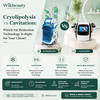
Cryolipolysis vs Cavitation: Which Fat Reduction Technology Is Right for Your Client?
, di Kashif Amin, 12 tempo di lettura minimo
Ottieni il 5% di sconto sul tuo primo acquisto
, di Kashif Amin, 12 tempo di lettura minimo
Cryolipolysis and cavitation are the two most widely used non-surgical fat reduction technologies in the body contouring market. This guide compares their mechanisms, results, costs, treatment areas, and client suitability to help clinicians choose the right technology for each client’s specific concern.
Cryolipolysis and cavitation are the two most widely used non-surgical fat reduction technologies in the body contouring market, and the question of which technology is right for a specific client is one of the most common clinical decisions that body contouring therapists face. Both technologies reduce subcutaneous fat volume through non-invasive means, but they work through fundamentally different mechanisms, deliver different types of results, have different cost profiles, and are suited to different client profiles and treatment areas. Understanding the differences between these two technologies — and knowing when to use each one — is one of the most important clinical competencies for a body contouring therapist.
This guide provides a comprehensive comparison of cryolipolysis and cavitation across the dimensions that matter most for clinical decision-making: mechanism of action, results profile, treatment areas, client suitability, cost, and the combination strategies that use both technologies together to deliver the most comprehensive fat reduction results.
Cryolipolysis works by applying controlled cooling to a targeted area of subcutaneous fat, reducing the temperature of the fat cells to a level that triggers apoptosis — programmed cell death — without damaging the overlying skin or surrounding tissue. Fat cells are more sensitive to cold than skin cells, which allows cryolipolysis to selectively destroy fat cells while leaving the skin intact. The destroyed fat cells are gradually eliminated by the body’s lymphatic system over the 8 to 12 weeks following treatment, producing a progressive reduction in the fat layer that is visible at 8 to 12 weeks and continues to develop for up to 6 months after treatment.
The key characteristic of cryolipolysis is that it permanently destroys fat cells. Once a fat cell has been destroyed by cryolipolysis, it cannot regenerate — the fat cell is gone permanently. This means that the fat reduction achieved by cryolipolysis is permanent, provided the client maintains a stable body weight after treatment. If the client gains significant weight after treatment, the remaining fat cells in the treated area can expand, partially reversing the result.
Cavitation works by applying ultrasonic waves to the subcutaneous fat layer, creating microscopic bubbles in the fat tissue that implode and disrupt the fat cell membranes. This disruption releases the fat cell contents — primarily triglycerides — into the interstitial fluid, where they are transported to the liver for metabolism and elimination. Unlike cryolipolysis, cavitation does not destroy the fat cells themselves — it disrupts the fat cell membranes and releases their contents, but the fat cells can refill with fat if the client’s caloric intake exceeds their caloric expenditure after treatment.
The key characteristic of cavitation is that it is a progressive treatment that delivers cumulative results over a course of sessions. A single cavitation session produces a modest reduction in the fat layer, but a course of 8 to 10 sessions over 4 to 5 weeks delivers a significant cumulative reduction that is visible and measurable. The results of cavitation are not permanent in the same way as cryolipolysis — the fat cells can refill if the client gains weight — but they are durable if the client maintains a healthy lifestyle after treatment.
Body contouring specialists who use both cryolipolysis and cavitation in their clinical practice consistently describe the two technologies as complementary rather than competitive. Cryolipolysis is the preferred technology for clients who want a permanent, significant reduction in a specific fat deposit with minimal treatment frequency — typically 2 to 3 sessions spaced 8 to 12 weeks apart. Cavitation is the preferred technology for clients who want progressive, affordable fat reduction with regular maintenance sessions, or for treatment areas where cryolipolysis applicators cannot achieve consistent contact. The most effective fat reduction programmes use both technologies in combination — cryolipolysis for the initial permanent fat reduction and cavitation for ongoing maintenance and for treatment areas that are not well suited to cryolipolysis.
Cryolipolysis delivers a permanent reduction in the fat cell count in the treated area, with a 20 to 25 percent reduction in the fat layer per session. The results are visible at 8 to 12 weeks after treatment and continue to develop for up to 6 months. A course of 2 to 3 cryolipolysis sessions delivers a cumulative fat reduction of 40 to 60 percent of the original fat layer — a significant and permanent result that is visible in standardised before-and-after photography.
Cavitation delivers a progressive reduction in the fat cell volume in the treated area, with a more modest per-session result than cryolipolysis but a significant cumulative result over a course of 8 to 10 sessions. The results of cavitation are visible within the first 3 to 5 sessions and continue to develop throughout the course. The fat reduction achieved by cavitation is not permanent in the same way as cryolipolysis — the fat cells can refill if the client gains weight — but it is durable if the client maintains a healthy lifestyle and continues with monthly maintenance sessions.
Cryolipolysis is most effective in areas with a well-defined, pinchable fat deposit that can be drawn into the cryolipolysis applicator by suction. The most effective treatment areas for cryolipolysis are the lower abdomen, the flanks (love handles), the upper abdomen, the inner and outer thighs, the upper arms, and the submental area (double chin). Cryolipolysis is less effective in areas where the fat deposit is too thin to be drawn into the applicator, where the skin is too loose to maintain consistent applicator contact, or where the anatomy of the treatment area makes consistent applicator placement difficult.
Cavitation is effective across a wider range of treatment areas than cryolipolysis, because the cavitation handpiece can be moved continuously over the treatment area without the applicator placement constraints of cryolipolysis. Cavitation is particularly effective in the abdomen, flanks, thighs, buttocks, and arms, and it can be used in areas where cryolipolysis applicators cannot achieve consistent contact — such as the inner knee, the upper back, and the lateral hip. Cavitation is also more effective than cryolipolysis for treating large treatment areas in a single session, because the handpiece can cover a larger surface area in the same treatment time.
The ideal cryolipolysis candidate is a client who is at or near their target body weight, has a well-defined, pinchable fat deposit in a specific treatment area, and wants a permanent, significant reduction in that fat deposit with minimal treatment frequency. Cryolipolysis is not appropriate for clients who are significantly overweight, because the fat reduction achievable with cryolipolysis is not sufficient to produce a meaningful result in a client with a large overall fat volume. It is also not appropriate for clients with very loose skin in the treatment area, because the suction of the cryolipolysis applicator can worsen the appearance of loose skin.
The ideal cavitation candidate is a client who wants progressive, affordable fat reduction with regular maintenance sessions, or who has a treatment area that is not well suited to cryolipolysis. Cavitation is also a good option for clients who are not ready to commit to the higher per-session cost of cryolipolysis, or who want to begin treatment immediately rather than waiting for the 8 to 12 week results timeline of cryolipolysis. Cavitation is appropriate for a wider range of body types and fat volumes than cryolipolysis, making it a more accessible entry-level fat reduction option for clients who are new to body contouring.
Cryolipolysis has a higher per-session cost than cavitation, reflecting the higher equipment cost and the longer treatment time per session. A single cryolipolysis session treating one area typically costs $200 to $400, depending on the local market and the clinic’s pricing strategy. A complete cryolipolysis programme of 2 to 3 sessions treating the abdomen and flanks might cost $1,200 to $2,400.
Cavitation has a lower per-session cost than cryolipolysis, making it a more accessible option for clients with a limited budget. A single cavitation session typically costs $80 to $150, and a complete cavitation programme of 8 to 10 sessions might cost $640 to $1,500. However, the total cost of a cavitation programme that delivers a comparable result to a cryolipolysis programme may be similar, because cavitation requires more sessions to achieve the same degree of fat reduction. The key commercial advantage of cavitation is the lower per-session cost, which makes it more accessible to price-sensitive clients and more suitable for regular maintenance sessions.
Cryolipolysis involves a suction sensation as the fat is drawn into the applicator, followed by an intense cold sensation that typically subsides within the first 5 to 10 minutes of treatment as the area becomes numb. The treatment is generally well tolerated, with most clients reading, working on their phone, or sleeping during the session. After the treatment, the treated area is massaged to break up the frozen fat tissue, which can be uncomfortable for 1 to 2 minutes. There is no downtime after cryolipolysis, but the treated area may be red, swollen, and tender for 1 to 2 weeks after treatment.
Cavitation involves a warm, tingling sensation as the ultrasonic waves are applied to the treatment area, and a low-frequency buzzing sound that is audible to the client during treatment. The treatment is generally comfortable and well tolerated, with no suction or cold sensation. There is no downtime after cavitation, and the treated area typically shows no visible reaction after treatment. Clients are advised to drink 2 to 3 litres of water after each cavitation session to support the lymphatic elimination of the released fat cell contents.
The most effective fat reduction programmes use cryolipolysis and cavitation in combination, leveraging the permanent fat cell destruction of cryolipolysis and the progressive, maintenance-friendly results of cavitation to deliver the most comprehensive and durable fat reduction result. The recommended combination strategy is to use cryolipolysis for the initial permanent fat reduction — 2 to 3 sessions treating the primary fat deposit — and cavitation for ongoing maintenance and for treatment areas that are not well suited to cryolipolysis.
The 360 Cryolipolysis Machine and the 5D RF Cavitation Machine are the recommended platforms for this combination strategy, delivering professional-grade cryolipolysis and cavitation results from a compact, clinic-ready equipment stack. The 5D RF Cavitation Machine’s integrated RF component adds skin tightening to the cavitation treatment, addressing the skin laxity that can accompany fat reduction and delivering a more comprehensive result than cavitation alone.
Choose cryolipolysis when the client has a well-defined, pinchable fat deposit in a treatment area that is well suited to cryolipolysis applicators, wants a permanent and significant fat reduction result, is willing to wait 8 to 12 weeks for the results to develop, and has the budget for the higher per-session cost of cryolipolysis. Cryolipolysis is the preferred technology for clients who want the most permanent and most significant fat reduction result from the fewest number of sessions.
Choose cavitation when the client wants progressive, affordable fat reduction with visible results within the first few sessions, has a treatment area that is not well suited to cryolipolysis applicators, wants to combine fat reduction with skin tightening in a single treatment session (using the integrated RF component of the 5D RF Cavitation Machine), or wants a regular maintenance treatment to sustain the results of a previous cryolipolysis programme. Cavitation is also the preferred technology for clients who are new to body contouring and want to begin with a lower-commitment, lower-cost treatment before investing in cryolipolysis.
Which technology gives better results, cryolipolysis or cavitation? Cryolipolysis delivers a more permanent and more significant per-session fat reduction result than cavitation, because it permanently destroys fat cells rather than simply releasing their contents. However, cavitation delivers visible results more quickly — within the first 3 to 5 sessions — and is more suitable for regular maintenance treatment. The best results are achieved by using both technologies in combination.
Can I use cryolipolysis and cavitation in the same session? Yes, but not on the same treatment area in the same session. Cryolipolysis and cavitation can be used on different treatment areas in the same appointment — for example, cryolipolysis on the abdomen and cavitation on the thighs — but they should not be used on the same area in the same session, because the tissue response to cryolipolysis requires time to develop before additional energy-based treatments are applied.
Is cryolipolysis or cavitation more painful? Neither technology is painful in the conventional sense. Cryolipolysis involves an intense cold sensation and suction that can be uncomfortable for the first few minutes of treatment, while cavitation involves a warm, tingling sensation that most clients find comfortable. The post-treatment massage after cryolipolysis can be briefly uncomfortable. Most clients tolerate both treatments well.
Wikbeauty supplies the 360 Cryolipolysis Machine and the 5D RF Cavitation Machine — the two most commercially effective fat reduction platforms for body contouring clinics. Our equipment specialists can help you design a combination fat reduction protocol and package structure that maximises the clinical results and the commercial performance of your clinic. Contact us today to discuss your clinic’s requirements.